Milne Technologies Home Products and Services Recent Projects Publications and Project Reports Senior Staff Research Collaborations and Data Sharing Contact Us


Habitat mapping and substrate classification of Lake Opeongo

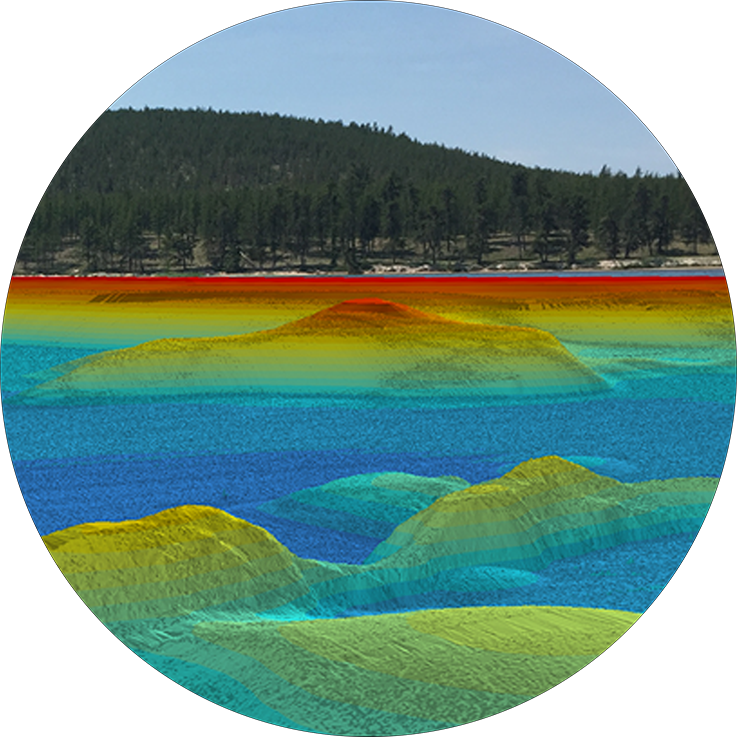
In the summer of 2008, Milne Technologies conducted hydroacoustic surveys for the purpose of classifying the substrate of Lake Opeongo, Ontario. Echo integration of the primary and secondary bottom reflections was used to provide a measure of relative substrate roughness and hardness. Several substrate classes were statistically identified using Quester Tangent's Impact seabed classification software. Further assessment of the identified substrate classes was then done using an underwater camera and Ekman dredge. The association of fish targets, including lake trout, with certain types of substrate and habitat can further be analyzed from these and similar future surveys. Click here for more information on how hydroacoustics can be used for habitat mapping and substrate classification.

Services provided for: Harkness Laboratory of FIsheries Research and the Ontario Ministry of Natural Resources

Field technology utilized for this project:
   •  Simrad EY500 120 kHz Split-beam
   •  Splashcam Deep Blue underwater camera
   •  Ekman dredge

Products delivered by Milne Technologies:
   •  Detailed bathymetric and substrate maps
   •  Lake bottom substrate classification and analysis (QTC, E1 Roughness and E2 Hardness)
   •  Data on the distribution of pelagic fish targets in relation to specific habitat features


Lake Huron Double-crested Cormorant Experimental Management Program

The purpose of this project is to provide hydroacoustic data processing and fisheries assessment services in support of the “Lake Huron Double-crested Cormorant Experimental Management Program”. The program was a multi-year study (2000-2005) aimed at monitoring the potential effects of double-crested cormorants on the nearshore and pelagic fish communities in the coastal areas of Georgian Bay and the North Channel.

Services provided for: Ontario Ministry of Natural Resources

Field technology utilized for this project:
   •  Simrad EY500 120 kHz Split-beam
   •  Fish sampling equipment including suspended gill nets and trap nets

Products delivered by Milne Technologies:
   •  Acoustic estimates of pelagic fish abundance and biomass
   •  Fish schooling behaviour analysis in relation to cormorant abundance
   •  Analysis of the spatial distribution of pelagic fish in relation to cormorant abundance
   •  Near-shore index trap-netting data analysis
   •  Bathymetric and habitat mapping

Report:
   •  Double-Crested Cormorant and Coastal Fish Monitoring and Assessment in the North Channel and Georgian         Bay, Lake Huron: Field Methods, Site Descriptions and Analysis Information. Download Full Report.


Integrating Remote Sensing Technologies: A Method for Sampling from Multiple Trophic Levels in Lakes

The purpose of this project was to develop a “rapid resource assessment methodology” that provides the ability to simultaneously sample from multiple trophic levels and across a wide size spectrum of organisms. Five coldwater lakes in Southern Ontario were surveyed with a suite of remote sensing technology. The lakes surveyed were Lake Opeongo (Algonquin Park), Smoke Lake (Algonquin Park), Drag Lake (Haliburton County), Dickey Lake (Hastings County), and Harp Lake (District Municipality of Muskoka).

Services provided for: Aquatic Ecology Group at the University of Toronto.

Field technology utilized for this project:
   •  120 kHz split-beam to assess the pelagic fish community
   •  710 kHz single beam acoustic system to determine the abundance and spatial distribution of zooplankton
   •  Optical plankton counter (OPC) to assess the abundance and size distribution of zooplankton at depth.
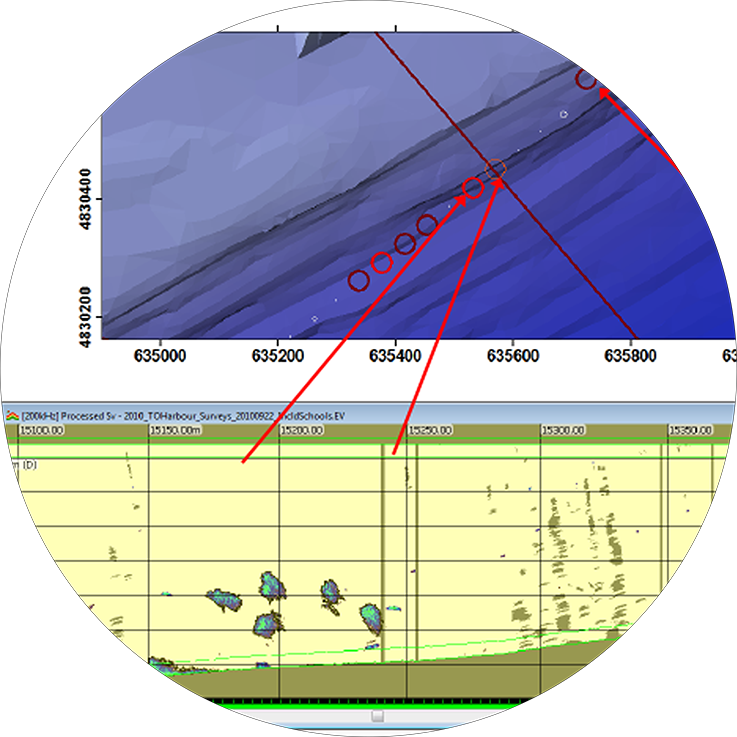
   •  SM2000 200 kHz multi-beam sonar was also deployed to observe and map the spatial distribution of lake herring
      schools.

Products delivered by Milne Technologies:
   •  lake trout density and biomass estimates
   •  analysis of the morphology and spatial distribution of lake herring schools
   •  model developed to estimate abundance and size distribution of zooplankton from high-frequency hydroacoustics       to compare with OPC estimates
   •  substrate analyses and classification
   •  bathymetric mapping products


Using Mulit-beam and Split-beam Hydroacoustic Technology to Detect and Track Ultrasonic Tagged Fish

The purpose of this project is to provide a method for directly measuring the in situ target strength of lake trout using integrated multibeam, split beam, and biotelemetry technologies. This work will also provide a unique opportunity to describe the spatial distribution and behavioural patterns of lake trout as they relate to the schooling behaviour of their prey. The field work is being conducted on Lake Opeongo in Algonquin Provincial Park, Ontario, Canada.

Partners: Ontario Ministry of Natural Resources, Kongsberg-Mesotech Simrad Ltd., SonarData Pty Ltd., and the University of Toronto at Mississauga.

Field technology utilized for this project:
   •  SM20 multibeam sonar
   •  EK60 multi-frequency echosounder system
   •  200 kHz pulse coded ultrasonic tags

Products delivered by Milne Technologies:
   •  methodology and results summary report
   •  in situ measurements of target strength of tagged lake trout
   •  lake trout behaviour manuscript
   •  combined frequency echogram analysis
   •  lake bottom substrate classification and analysis (QTC, E1 Roughness and E2 Hardness)

Report:
   •  Using Hydroacoustic Technology to Detect and Track Ultrasonic Tagged Fish: Methodology and Preliminary       Results.  Download Report Excerpt.
   •  Click here to see replays of a series of multibeam echogram movies that were recorded during the 2007
      tracking surveys. Go to our lake trout behaviour page.


Understanding the Impact of the Double-crested Cormorant Management Program and the Walleye Rehabilitation Program on the Prey Fish Community of Lac La Biche

The aquatic communities of lakes across Canada are impacted by a number of stresses including habitat degradation, introduction of exotic species, water diversion, climate change, and over-exploitation. Alberta's Lac La Biche has been impacted by the effects of hyper-eutrophication resulting in blooms of toxic blue-green algae, declines in water quality, and fluctuating water levels. Another concern is the observed declines in the commercial and sport fisheries that have been attributted to factors including the increase in piscivorous bird populations (pelicans and cormorants), over-exploitation, and larval fish bottlenecks as a result of increased planktivorous fish production. Recently, the Alberta Sustainble Resource Development introduced a series of management initiatives to return trophic stability to the system. Measures taken include the intensive reintroduction and rehabilitatation of walleye and northern pike within the system as well as intensive management and culling of double crested cormorant colonies. These management changes are expected to impact the species composition and abundance of the planktivorous fish community in the lake. 

The purpose of this project was to design and implement a long-term hydroacoustic survey program for assessing changes in the size, spatial distribution, and abundance of prey fish in Lac La Biche in response to management decisions. The time series of data provided by annual and biannual hydroacoustic surveys will allow the early detection of ecosystem changes and perturbations that will enable managers to respond using an adaptive management plan.

To detect and quantify the number of fish that might have been undersampled within the vertical surveys, a second 200 kHz transducer was used to sample the shallower (< 4 m) regions of the water column. With this method, the split beam transducer was mounted on the tow-body to point away from the survey vessel in a horizontal orientation thus insonifying a large volume of water just below the surface. 

Services provided for: Sustainable Resource Development, Government of Alberta

Field technology utilized for this project:
   •  BioSonics DTX 200 kHz split-beam

Products delivered by Milne Technologies:
   •  echo integration estimates of pelagic fish density and biomass
   •  spatial distribution of fish density and biomass
   •  lake bottom substrate classification and analysis (QTC, E1 Roughness and E2 Hardness)
   •  bathymetry, habitat and submerged macrophyte mapping

Reports:
   •  2006 Lac La Biche Hydroacoustic Survey Report: Methodology and Summary of Results.
   •  2007 Lac La Biche Hydroacoustic Survey Report: Methodology and Summary of Results. Table of Contents.


The Potential Impacts of the 2005 Oil Spill on the Fish Community and Habitat of Wabamun Lake

Wabamun Lake recently received national attention when, in August 2005, a train derailment near the town of Whitewood, Alberta spilled 750,000 litres of heavy bunker oil into the lake. The short-term impacts were obvious (e.g., contaminated drinking and bathing water, beach closures, wildlife fouling, etc.), but the long-term ecological impacts of the spill on the lake are unknown. To further understand the ecological impacts of the oil spill and to effectively manage the fish communities within the lake, the Alberta Sustainable Resource Development (SRD) has initiated a long-term fisheries assessment and monitoring program. In consultation with Milne Technologies, the Alberta SRD has designed and implemented a hydroacoustic survey program to assess changes in the size and abundance of the lake whitefish population in the lake.

To detect and quantify the number of fish that might have been undersampled within the vertical surveys, a second 200 kHz transducer was used to sample the shallower (< 4 m) regions of the water column. With this method, the split beam transducer was mounted on the tow-body to point away from the survey vessel in a horizontal orientation thus insonifying a large volume of water just below the surface. 

Services provided for: Sustainable Resource Development, Government of Alberta

Field technology utilized for this project:
   •  BioSonics DTX 200 kHz split-beam

Products delivered by Milne Technologies:
   •  echo integration estimates of pelagic fish density and biomass
   •  spatial distribution of fish density and biomass
   •  lake bottom substrate classification and analysis (QTC, E1 Roughness and E2 Hardness)
   •  bathymetry, habitat and submerged macrophyte mapping

Reports:
   •  2006 Wabamun Lake Hydroacoustic Survey Report: Methodology and Summary of Results.
   •  2007 Wabamun Lake Hydroacoustic Survey Report: Methodology and Summary of Results. Table of Contents.


Hydroacoustic Assessment of Lake Trout in Grist Lake and Cold Lake

Cold Lake and Grist Lake are two of only a handful of lakes in Alberta that provide suitable habitat for naturally reproducing populations of lake trout. There is increasing pressure on Alberta’s wetlands, lakes, and rivers from stresses including climate change, introduction of exotic species, over-exploitation, and loss of biodiversity. The effective management and conservation of lake trout populations throughout the province is critical to ensure protection of the resource for generations to come.

The purpose of this project was to design and implement a long-term hydroacoustic survey program to assess and monitor changes in the size, spatial distribution, and abundance of lake trout. This project also provided a direct comparison of abundance estimates generated from the hydroacoustic method and the Alberta standardized gill net index (SPIN) program. 

Services provided for: Sustainable Resource Development, Government of Alberta

Field technology utilized for this project:
   •  BioSonics DTX 200 kHz split-beam

Products delivered by Milne Technologies:
   •  echo integration estimates of pelagic fish density and biomass
   •  fish tracking analysis and echocounting estimates of lake trout density and biomass
   •  analysis of the morphology and spatial distribution of lake herring schools
   •  spatial distribution of fish density and biomass
   •  lake bottom substrate classification and analysis (QTC, E1 Roughness, and E2 Hardness)
   •  bathymetry, habitat and submerged macrophyte mapping

Reports:
   •  2006 Cold Lake Hydroacoustic Survey Report: Methodology and Summary of Results.
   •  2007 Cold & Grist Lake Hydroacoustic Survey Report: Methodology and Summary of Results. Table of Contents.


The Response of Lake Trout Populations to Re-opened Winter Fisheries

In collaboration with Milne Technologies and the Ontario Ministry of Natural Resources, the Wildlife Conservation Society of Canada designed and implemented a hydroacoustic survey program in an effort to detect potential changes in the population abundance and size distribution of lake trout in Myrt and Hood Lakes (Thunder Bay district of Ontario). Both lakes were closed to ice fishing but in February 2008, the Ontario Ministry of Natural Resources re-opened the lakes to winter angling. This management change provided a unique opportunity to directly measure the response of the lake trout populations to the change in regulations and the increased level of fishing effort.

Services provided for: Wildlife Conservation Society

Field technology utilized for this project:
   •  BioSonics DTX 120 kHz split-beam
   •  OMNR standardized index gill nets

Products delivered by Milne Technologies:
   •  lake trout density and biomass estimates
   •  lake bottom substrate classification
   •  bathymetry and habitat mapping

Report:
   •  2007 Myrt and Hood Lakes Hydroacoustic Survey Report: Abundance and spatial distribution of lake trout
      (Salvelinus namaycush) in two Northern Ontario lakes. Table of Contents.


Milne Technologies Home Products and Services Contact Us